
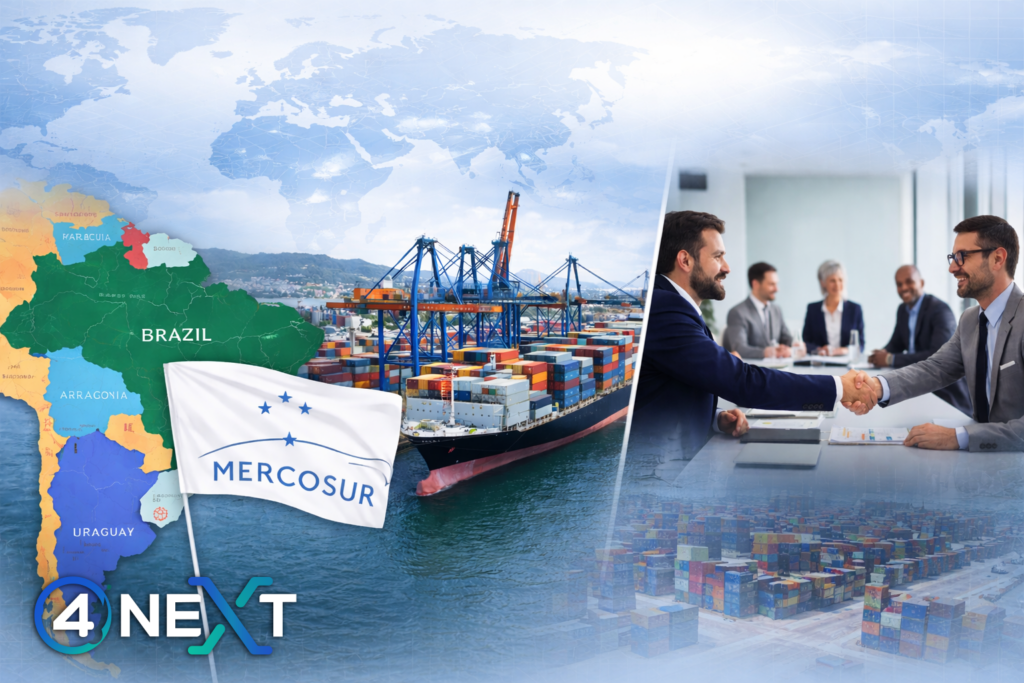
What is Mercosur? An overview
Mercosur, formally known as the Southern Common Market, is one of the world’s most influential regional trade blocs. Established in 1991, its primary objective is to promote free trade and economic integration between its member states through the reduction of tariffs, coordinated trade policies, and improved cross-border cooperation.
The core Mercosur members are Brazil, Argentina, Paraguay, and Uruguay, with several associate members including Chile and others across South America. Together, Mercosur represents a combined population of over 270 million people and a GDP exceeding USD 2 trillion, making it a critical trading region not just for South America, but for global supply chains.
For logistics providers and freight forwarders, Mercosur is far more than a political or economic agreement. It directly shapes how goods move across borders, how customs processes are managed, and how regional and international trade lanes are structured.
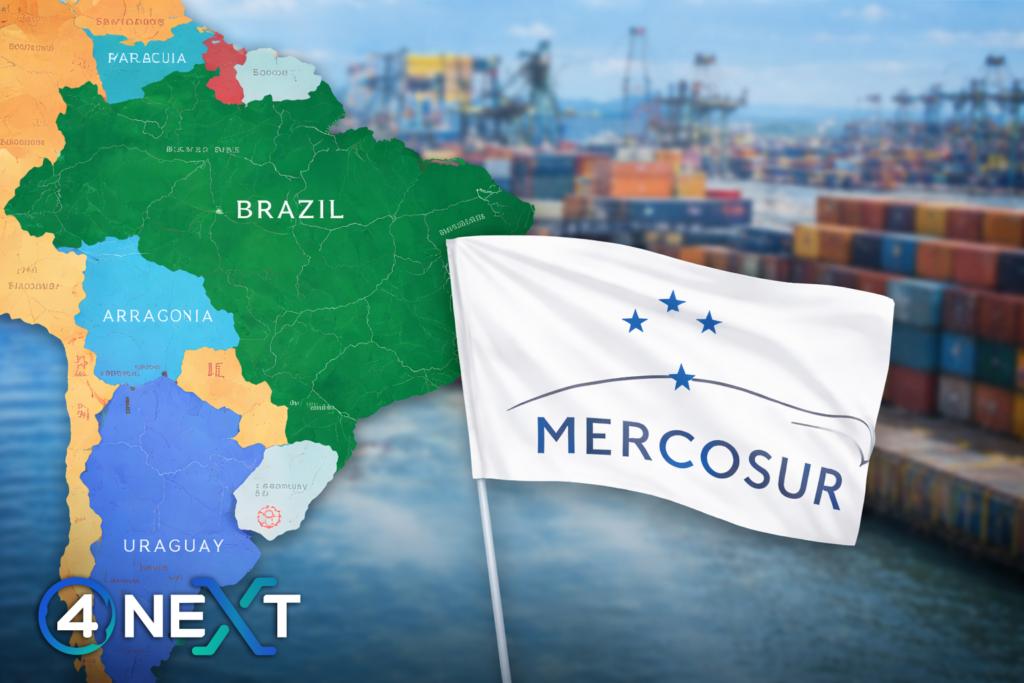
Current Mercosur trends in 2024–2025, and what’s ahead for 2026
Over the past two years, Mercosur has experienced renewed momentum. After a prolonged period of political uncertainty and slow progress on trade liberalisation, several key trends have emerged that are particularly relevant for the logistics and freight forwarding industry.
One of the most significant developments has been the increased focus on external trade agreements. Negotiations between Mercosur and the European Union have regained traction, while discussions with Asian markets continue to expand. These efforts are aimed at opening new export routes for agricultural products, raw materials, and manufactured goods, all of which place increased demand on freight forwarding networks, multimodal transport solutions, and customs expertise.
Digitalisation is another major trend. Customs authorities across Mercosur countries are accelerating the adoption of electronic documentation, single-window systems, and data-sharing platforms. While implementation varies from country to country, the overall direction is clear: faster clearance, improved transparency, and reduced administrative friction. For forwarders that are digitally prepared, this creates opportunities to move goods more efficiently and offer added-value services to clients.
Infrastructure investment has also returned to the agenda. Ports in Brazil and Argentina are undergoing capacity expansions, inland transport corridors are being modernised, and public-private partnerships are playing a growing role in logistics development. These projects are expected to continue into 2026, improving regional connectivity and making intra-Mercosur trade more predictable and scalable.
Looking ahead, sustainability will become increasingly influential. Environmental standards, emissions reporting, and greener transport solutions are already shaping procurement decisions for global shippers. Freight forwarders operating in Mercosur will need to adapt by working with compliant carriers, optimising routes, and supporting clients with sustainability reporting requirements.
Why Mercosur matters to logistics and freight forwarding companies
Mercosur directly impacts how logistics companies operate within South America and how international freight flows connect into the region.
Reduced tariffs and harmonised trade policies lower barriers for cross-border movement, but they also introduce complexity. Rules of origin, documentation requirements, and regulatory variations still require deep local knowledge. This is where experienced freight forwarders play a vital role, acting as the link between policy and practical execution.
The scale of Mercosur trade also creates volume-driven opportunities. Agricultural exports, energy products, automotive components, consumer goods, and industrial machinery all move in significant quantities across Mercosur borders and beyond. Managing these flows efficiently requires strong regional partnerships, reliable agents, and real-time communication.
For global forwarders and SMEs alike, Mercosur presents a balance of opportunity and challenge. Those who rely solely on transactional relationships often struggle with inconsistencies, while those embedded in trusted networks are better positioned to respond quickly, solve problems, and win long-term business.
Mercosur’s importance to 4NEXT Global and its members
For 4NEXT Global, Mercosur represents a strategic region where collaboration, connectivity, and trusted relationships matter more than ever.
4NEXT Global’s community-driven model aligns naturally with the realities of operating in Mercosur. Trade within and beyond the region depends heavily on local expertise, cultural understanding, and strong professional relationships. By bringing together freight forwarders, logistics providers, and industry partners from across South America and key global markets, 4NEXT helps its members bridge gaps that cannot be solved by technology alone.
Many 4NEXT Global members already have active coverage in Mercosur countries and wider Latin America, including Brazil and Chile, as well as strong links into Mexico and other key trade gateways. This creates tangible value for members seeking reliable partners for imports, exports, and cross-trade movements involving Mercosur lanes.
Rather than relying on unknown agents or fragmented contacts, members can connect with vetted professionals who understand both local regulations and international expectations. This reduces risk, improves service consistency, and supports sustainable commercial growth.
Why Mercosur strengthens the case for 4NEXT Global membership
One of the core advantages of being part of 4NEXT Global is access to a genuinely engaged network. This becomes especially important in regions like Mercosur, where personal relationships and trust play a decisive role in how business is done.
Through 4NEXT’s digital platform, members can communicate directly, explore new trade opportunities, and follow up on live prospects across Mercosur-related lanes. This is complemented by physical networking events, which allow members to build deeper connections that translate into smoother operational collaboration.
For freight forwarders looking to expand their footprint in South America, 4NEXT provides a practical entry point. Members can identify partners with proven regional expertise, exchange market insights, and align on service standards before committing to new trade flows.
For existing Mercosur specialists, the network offers exposure to international partners seeking reliable regional coverage. This supports inbound business development and helps members position themselves as trusted gateways into South American markets.

Bringing it all together: Mercosur, connectivity, and the future
Mercosur will continue to shape the future of trade in South America and beyond. As tariffs evolve, infrastructure improves, and digital systems mature, logistics and freight forwarding professionals will play an increasingly strategic role in enabling trade growth.
Success in this environment depends not only on operational capability, but on collaboration, visibility, and shared expertise. Networks like 4NEXT Global help turn regional complexity into opportunity by connecting the right people, at the right time, with the right tools.
For members operating in or trading with Mercosur markets, being part of a trusted global community is no longer a nice-to-have. It is a competitive advantage that supports resilience, growth, and long-term success in an increasingly interconnected logistics landscape.
Join us in 2026:
As Mercosur continues to shape trade flows across South America and beyond, 2026 presents a real opportunity for logistics and freight forwarding professionals who want to strengthen their regional and global connectivity.
For the 4NEXT Global network, Mercosur represents collaboration in action — bringing together trusted partners, local expertise, and international reach across key markets such as Brazil, Argentina, Uruguay, Paraguay, Chile and wider Latin America.
If you’re looking to expand your international footprint, build stronger partnerships within high-growth trade regions, and be part of a global logistics community that values connection, collaboration, and real commercial outcomes, we invite you to explore membership with 4NEXT Global.
Join us as we continue to grow our network, support our members, and create new opportunities across Mercosur and global trade lanes in 2026 and beyond.
You can contact us today to join or learn more about member benefits by emailing us at info@4nextglobal.com or calling on +905323691686.